Cowboy Boot Toe Styles: Complete Guide
Choosing the right cowboy boot toe style shapes how your boots look, feel, and perform every time you wear them. Whether you’re riding horses, working long shifts, or dressing up for a night out, the toe design plays a crucial role in comfort and function. From the sharp elegance of a pointed toe to the roomy practicality of a wide square toe, each style serves a distinct purpose. This guide breaks down every major cowboy boot toe type, explains what they’re designed for, and shows you how to pick the one that fits your life.
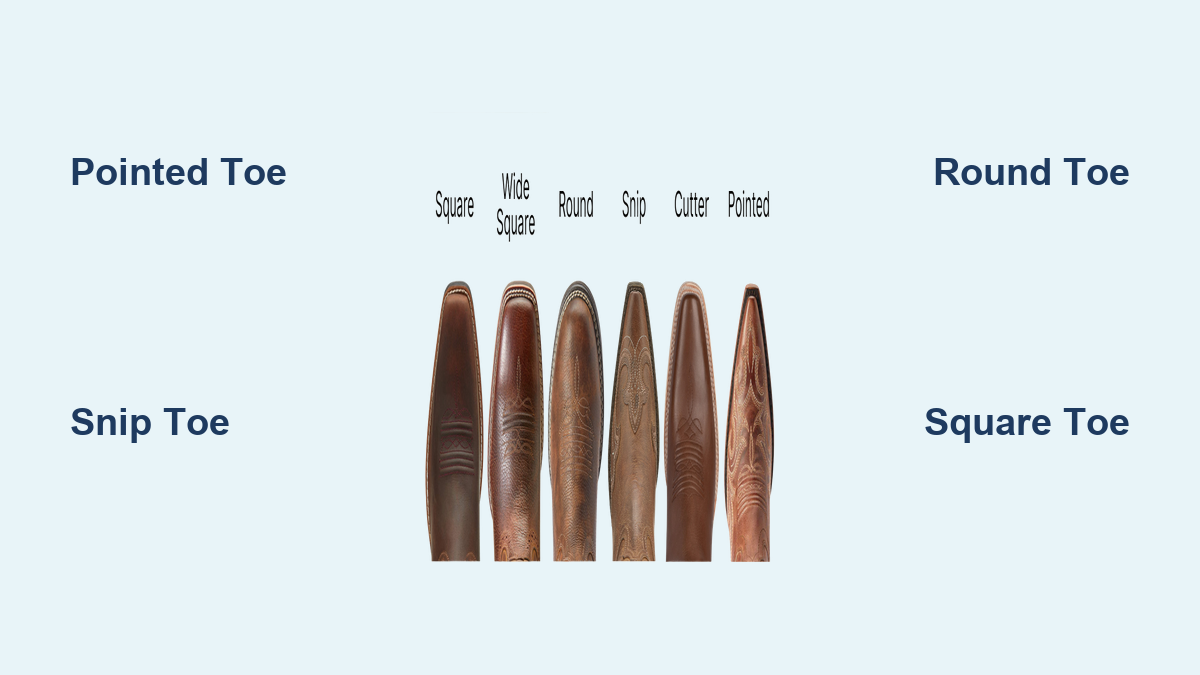
Pointed Toe (J/1/S Toe)
The pointed toe is the original Western silhouette, built for function and refined for fashion over generations.
Why It’s Called a “Roach Killer”
The extreme version of this toe, known as the S Toe or “Roach Killer,” earned its nickname from its sharp tip, said to be able to squash pests in barns. While modern versions are less dramatic, they still carry that bold, aggressive profile.
Designed for Stirrup Speed
The primary reason for the pointed design is fast entry into stirrups. Riders can slide their foot in quickly without catching, making it ideal for ranch work or trail riding. The narrow front reduces snagging and improves control in the saddle.
Best For Narrow Feet and Dressy Looks
This style tapers sharply, offering a snug fit that flatters narrow feet. It pairs perfectly with slim jeans or tailored pants, creating a sleek, elongated leg line. Most pointed-toe boots come with a 1 1/2-inch Western heel, enhancing the polished look.
Pro Tip: If you have wide feet or wear thick socks, avoid standard pointed toes. They can pinch over time.
Snip Toe (X/N/A Toe)
The snip toe blends tradition with modern edge, making it a favorite among fashion-forward cowboys.
What Makes It “Snipped”
Unlike the sharp tip of a pointed toe, the snip toe ends in a flat, cut-off edge. It starts narrow like a J toe but finishes with a squared-off tip, giving it a bold, architectural look without sacrificing too much toe room.
Stylish Yet Functional
While not as efficient in stirrups as a true pointed toe, the snip still allows easy mounting thanks to its tapered front. It’s a hybrid: dressy enough for weddings and concerts, rugged enough for daily wear.
Ideal for Making a Statement
Marketed as a “fashion toe” (especially the A Toe variant), this style stands out in a crowd. Its flat tip gives boots a contemporary, almost avant-garde flair, perfect for those who want to honor Western roots while looking cutting-edge.
Wear With: Boot-cut jeans, dress slacks, or leather jackets. Avoid tight ankle jeans, as they cut off the boot’s clean lines.
Round Toe (R/W/Roper Toe)
The round toe is the go-to choice for comfort, versatility, and timeless appeal.
The Classic “Natural Shape”
With a symmetrical, curved profile, the round toe mirrors the natural shape of the foot. It doesn’t taper or square off, allowing toes to rest comfortably without pressure points, ideal for all-day wear.
Top Pick for First-Time Buyers
If you’re new to cowboy boots, start here. The R Toe (or W Toe) offers a balanced fit for average-width feet and is rarely too tight or too loose. It’s forgiving, stylish, and works with almost any outfit.
Two Variants, Two Uses
- Roper Round Toe: Paired with a 1-inch straight heel, this version is built for walking. Popular among ranchers and rodeo crews who spend hours on hard ground.
- Classic Round Toe: Fitted with a 1 1/2-inch Western heel, it maintains traditional proportions for semi-formal and dressy occasions.
Expert Note: Despite brand-specific names like “6 Toe,” most round styles serve the same purpose: comfort first, style second.
Square Toe (French/Hognose Toe)
Modern, structured, and roomy, the square toe redefined Western footwear in the late 20th century.
Flat Front, Bold Look
Also known as the French Toe or Hognose Toe, this style features a flat, squared-off tip that creates a strong, boxy silhouette. It’s wider than a round toe and projects confidence with every step.
Built for Long Hours
Engineered for workers who stand all day, the square toe provides ample toe box space, reducing fatigue and preventing toenail bruising. It’s a favorite in outdoor jobs, construction, and agriculture.
Pairs Well With Casual Wear
This toe shines with boot-cut or straight-leg jeans. The wide front balances the bulk of heavy denim, creating a proportional look. Avoid pairing with skinny jeans, as they make the toe appear oversized.
Heel Match: Usually paired with either a 1 1/2-inch Western heel for style or a 1-inch roper heel for comfort.
Wide Square Toe (Broad Square)
When you need maximum space and durability, the wide square toe delivers.
More Volume, Less Squeeze
Also called the Broad Square Toe, this style takes the standard square toe and widens it significantly. The result is a roomy, almost “boxed” interior that accommodates wide feet, orthotics, or thick wool socks.
Go-To for Wide Feet
If regular boots pinch your toes, this is your solution. It eliminates lateral pressure and prevents blisters during extended wear. Many brands design this toe specifically for ranchers, rodeo athletes, and outdoor laborers.
Rugged Aesthetic, Modern Vibe
Though not the most refined look, the broad square toe has a tough, grounded presence. It signals function over fashion, but done well, it can still look stylish in casual Western settings.
Pair With: A 1-inch roper heel for better balance and reduced foot strain.
Cutter Toe
The cutter toe is a performance-driven hybrid, blending style and utility for serious riders.
Hybrid Design: Square Base, Tapered Front
It looks like a square toe with a slimmer profile, narrower than a broad square but flatter than a snip. This unique shape allows for quick stirrup entry while maintaining stability in the saddle.
Favored by Rodeo Competitors
Used by barrel racers, team ropers, and working cowboys, the cutter toe provides optimal control and foot positioning. The flat tip prevents rolling inside the stirrup, reducing accident risk.
Sharp Enough for Dress Boots
Unlike purely functional work toes, the cutter maintains a sleek, stylish appearance. It’s a great middle ground for those who want a distinctive look without sacrificing performance.
Heel Pairing: Typically paired with a 1 1/2-inch Western heel to preserve riding posture and elegance.
Narrow and Medium Round Toes
These refined versions of the classic round toe offer subtle differences in silhouette and fit.
Narrow Round Toe: Sleek and Streamlined
Slightly tapered toward the front, this toe creates a more tailored look than the standard round. It’s perfect for pairing with slim-fit jeans or suits where a clean line matters.
- Best For: Narrow to medium feet
- Occasion: Formal events, office wear, city outings
- Heel: Paired with a 1 1/2-inch Western heel
Style Tip: Think of this as the “dress round toe,” same comfort, sharper appearance.
Medium Round Toe: Balanced and Versatile
Fuller than the narrow version but not as bulbous as older round styles, the medium round toe strikes a balance between comfort and proportion.
- Best For: Average foot width
- Occasion: Everyday wear, office, casual dinners
- Heel: Usually features a 1 1/2-inch Western heel
Why It Works: It’s the Goldilocks of toe shapes, not too wide, not too narrow.
Western Box Toe
The Western box toe brings old-school structure to modern craftsmanship.
Structured, Not Squared
Despite the name, this isn’t the same as a square toe. The Western box toe has a slightly squared front but retains a more refined, traditional shape. It’s often found on heritage-style boots that emphasize durability and symmetry.
Timeless Over Trendy
This toe leans into classic Western aesthetics, appealing to purists who value craftsmanship over flash. It’s less common than round or square but holds a loyal following.
Ideal for Dress and Work
Thanks to its balanced proportions, it works well in both formal and functional contexts. Paired with a 1 1/2-inch Western heel, it maintains a dignified, upright stance.
Brand Note: Some makers use “box toe” interchangeably with “square,” so check the actual shape before buying.
How Toe Shape Affects Fit

Shape Doesn’t Equal Width (But It Feels Like It)
A common myth suggests that a wider external toe means a wider internal fit. In reality, fit is determined by the ball of the foot and instep, not the toe box shape. However, different toe styles feel different due to internal volume:
- Most Room: Wide Square > Square > Round
- Least Room: Pointed > Narrow Round > Snip
Even if two boots have the same width size, a pointed toe will feel tighter than a square one.
What Really Matters: Internal Volume
While the leather will stretch slightly over time, you can’t reshape a narrow toe into a wide one. Choose based on how your foot moves inside:
– Do your toes hit the front? Try a round or square.
– Do your feet slide forward? A pointed or narrow round may help.
Test Tip: Always try boots on with the socks you plan to wear. Wiggle room at the heel is normal; pinching at the toes is not.
Matching Toe Style to Your Lifestyle

You’re a Rider? Go Pointed, Snip, or Cutter
These toes are designed for stirrup efficiency:
– Pointed (J/1/S): Fastest entry, classic look
– Snip (X/N): Stylish alternative with easier fit
– Cutter: Best of both worlds, performance and control
Avoid wide square toes for riding, as they’re too bulky and can catch.
Working Long Shifts? Choose Wide Square or Round
For all-day comfort:
– Wide Square: Maximum room, ideal for thick socks
– Round Toe (Roper): Balanced fit, great for walking
Both reduce fatigue and prevent foot damage over time.
Dressing Up? Snip, Pointed, or French Toe
For formal events, aim for sleek silhouettes:
– Snip Toe: Bold and modern
– Pointed Toe: Timeless and elegant
– French (Square) Toe: Polished and structured
Pair with a 1 1/2-inch heel and dark-wash or black jeans.
First-Time Buyer? Start With Round or Medium Round
These offer:
– Forgiving fit
– Easy styling
– Low break-in time
They’re the safest entry point into cowboy boot culture.
Have Wide Feet? Prioritize Wide Square or Square
Don’t squeeze into a pointed toe hoping it’ll stretch. Choose:
– Broad Square Toe: Most internal space
– Standard Square Toe: Good balance of room and style
Many brands offer wide-width options in these styles.
Have Narrow Feet? Pointed or Narrow Round Is Your Friend
These prevent:
– Excess sliding
– Heel rub
– Poor alignment
They give a tailored, secure feel without needing excessive heel grip.
Heel and Toe Pairing Guide

| Toe Style | Recommended Heel | Height | Best Use Case |
|---|---|---|---|
| Pointed | Western Heel | 1 1/2″ | Riding, Dressy Events |
| Snip | Western Heel | 1 1/2″ | Formal, Night Out |
| Round (Classic) | Western Heel | 1 1/2″ | Versatile, Semi-Formal |
| Round (Roper) | Straight Roper Heel | 1″ | Walking, Ranch Work |
| Square | Western or Roper Heel | 1–1.5″ | Casual, Workwear |
| Wide Square | Straight Roper Heel | 1″ | All-Day Comfort, Wide Feet |
| Cutter | Western Heel | 1 1/2″ | Rodeo, Performance Riding |
| Western Box | Western Heel | 1 1/2″ | Traditional, Dress Boots |
Rule of Thumb: Higher heels (1 1/2″) read as dressier and more traditional. Lower heels (1″) offer more comfort for walking.
Frequently Asked Questions About Cowboy Boot Toe Styles
What is the most comfortable cowboy boot toe style?
The wide square toe (broad square) and round toe styles are widely considered the most comfortable. They offer ample room for toes to spread naturally, making them ideal for all-day wear, especially for people with wider feet or those who wear thick socks.
Which toe style is best for horseback riding?
Pointed toes (J/1/S), snip toes, and cutter toes are best for riding. Their tapered or flattened profiles allow for quick and safe entry into stirrups. The pointed toe offers the fastest insertion, while the cutter provides added stability.
What is the difference between a square toe and a wide square toe?
A standard square toe has a flat, squared-off front with moderate width. A wide square toe (or broad square) takes that same flat front but widens it significantly, creating a more “boxed” appearance and offering substantially more internal room.
Are pointed cowboy boots out of style?
Pointed cowboy boots remain a classic and are far from out of style. While square and wide square toes have surged in popularity for casual and work settings, pointed toes are still the go-to choice for traditional Western fashion, dressy occasions, and riding.
What is a “roach killer” toe?
A “roach killer” refers to an extreme version of the pointed toe, also known as the S Toe. It earned its nickname from its sharp tip, which was said to be able to crush pests in barns. Modern versions are less dramatic but retain a bold, aggressive profile.
How do I know which toe shape fits my foot?
Fit is determined by the ball of your foot and instep, not the toe shape itself. Try boots on with the socks you plan to wear. If your toes hit the front, try a round or square style. If your feet slide forward, a pointed or narrow round may provide a more secure fit.
Final Thoughts on Choosing Cowboy Boot Toe Styles
Cowboy boot toe styles are more than fashion choices. They’re functional tools shaped by history, labor, and lifestyle. Whether you’re drawn to the sharp precision of a pointed toe or the spacious comfort of a wide square, there’s a perfect match for your feet and your life.
Use this guide to cut through the confusion of brand-specific names like “J Toe” or “6 Toe” and focus on what matters: fit, function, and personal style. Once you know your needs, choosing the right toe becomes simple, and your boots will look better, feel better, and last longer.