How Salomon Hiking Boots Fit: Sizing Guide
If you’re asking, “How do Salomon hiking boots fit?” — you’re not alone. This is one of the most common and critical questions among hikers, backpackers, and trail runners considering Salomon’s high-performance footwear. Known for their precision engineering, responsive soles, and trail-ready stability, Salomon boots are built for control and agility. But their fit? That’s where things get complicated.
Many users report that Salomon hiking boots feel tight out of the box, run smaller than expected, or squeeze wider feet uncomfortably. Some swear by their locked-in feel, while others have returned multiple pairs searching for comfort. The truth is, Salomon hiking boots are designed to fit snugly — often half to a full size small and narrower than average, especially in the midfoot and toe box.
This performance-oriented fit isn’t a flaw — it’s intentional. But it means true-to-size (TTS) doesn’t always mean true-to-comfort. Getting the size wrong can lead to blisters, heel slippage, or bruised toes on long descents. That’s why understanding Salomon’s fit quirks is essential before you hit the trail.
In this guide, we’ll break down everything you need to know: whether to size up or down, how fit varies across models, what to expect during break-in, and how to test for a perfect fit. Whether you’re a first-time buyer or a long-time user, this will help you avoid costly mistakes and find the right Salomon boot for your foot.
Snug Fit by Design: Built for Control, Not Comfort
Salomon hiking boots are engineered for precision and stability, not loose, roomy comfort. Unlike brands that prioritize volume or width, Salomon uses a performance fit philosophy — meaning the boot hugs your foot tightly to prevent internal movement on technical terrain.
What “Snug” Really Means
- Tight at first: Most users report initial tightness, especially across the instep and forefoot.
- Minimal stretch: Unlike full-grain leather boots, Salomons (often made with synthetic mesh and TPU) don’t stretch much over time.
- Heel lockdown is critical: A secure heel prevents slippage and hot spots during downhill travel.
- Designed to mold slightly: EVA midsoles and textile linings conform to your foot over 5–7 days of wear.
⚠️ Warning: If your Salomons are painfully tight when new, they likely won’t improve enough for long hikes. Don’t assume break-in will fix a bad fit.
This snug feel isn’t a flaw — it’s intentional. But it means true-to-size (TTS) may not feel comfortable right away, and many people end up sizing up.
Do Salomon Hiking Boots Run Small?
Yes — most Salomon hiking boots run small, though the degree varies significantly by model and user.
Why Users Size Up
- Half to full size small is the most common feedback.
- Narrow midfoot and toe box squeeze wider or high-volume feet.
- Sock thickness matters: Thicker hiking socks often require +0.5 size.
- Inconsistent sizing across models: One model may fit TTS; another needs +1.
Real User Examples:
- “I wear a 10 in Merrells — had to go to a 10.5 in Salomon Quest 4D.”
- “My Lowas are 8.5, but I wear an 8 in Salomons.”
- “I need a 14 in Salomons but a 13W in everything else.”
🔍 Key Insight: There’s no universal rule. Fit depends on model, year, and foot shape. Always verify per model.
Are Salomon Boots Too Narrow?
Yes — Salomon boots are generally narrower than average, especially newer models.
Fit by Foot Width
| Foot Type | Fit Experience | Recommended Action |
|---|---|---|
| Narrow feet | Ideal fit in standard sizes | Stick to TTS |
| Medium-width feet | May feel snug | Consider +0.5 size |
| Wide feet | Often too tight | Size up or choose wide model |
💬 “All their new stuff seems to be running narrower than before. That’s why I stepped away from them now.”
Wide-Width Options
- Salomon XA Pro 3D V9 Wide
- Salomon Quest 4D Wide (limited availability)
- Salomon Ultra Glide Wide (trail running)
🛠️ Expert Note: Even within the same model line, non-wide and wide versions may not fit identically. Always test or research specific variants.
Should You Size Up in Salomons?
Not automatically — and never just for break-in.
When to Size Up
✅ Go up 0.5 size if:
– You’re between sizes
– Wearing thick hiking socks
– Hiking downhill frequently (to prevent toe jam)
– You have medium to wide feet
✅ Go up a full size or choose wide if:
– You have wide or high-volume feet
– Standard models feel constricting
– Using orthotics (removing insole adds space)
❌ Do NOT size up if:
– You’re counting on break-in to fix tightness
– Your heel slips more than a finger’s width
– You lose midfoot support
📌 Golden Rule: “If between sizes, go up half a size — not down.”
Sizing down risks pressure points and restricted circulation. Sizing up too much risks instability and injury.
Model-Specific Fit Guide: Not All Salomons Fit the Same

Fit varies significantly across models — even within the same line.
Popular Models & Fit Profiles
| Model | Fit Notes | Sizing Advice |
|---|---|---|
| XA Pro 3D V8/V9 | Runs small, narrow | +0.5 to +1; wide version available |
| Quest 4D | Snug midfoot, stiff break-in | +0.5 with thick socks |
| Ultra Raptor | Narrow toe box | +0.5 for wide feet |
| GORE-TEX T6 / XT-6 | Slim, fashion-forward | +0.5 to +1; avoid for wide feet |
| Speedcross | True to size for runners | Standard size OK; narrow fit |
| Sense Ride | Very snug, sock-like | +0.5; insole removal may require +1 |
| Jungle Boot | Closer to TTS | Try standard first |
| ACS+ | Tight, compressive fit | +0.5 for comfort |
💬 “My Jungles fit TTS. XA Mids I had to go half size up because they’re narrow.”
💬 “Got the XT-6 Gore-Tex — EU 45 was tight, 45 1/3 fit better on one foot.”
💡 Pro Tip: Always search “[Model] fit Reddit” or “Salomon [Model] runs small?” before buying.
Break-In: What to Expect
Salomon boots do not stretch like leather, but materials do soften.
Break-In Timeline
- Days 1–3: Wear around the house or on short walks.
- Days 4–7: Light trails, errands, gradual use.
- After 7 days: Full trail readiness.
Materials like EVA foam and textile uppers compress and conform, reducing hot spots. The Endofit liner adapts to your foot shape, improving heel lock.
✅ What improves: Midfoot comfort, heel stability, pressure point relief
❌ What doesn’t change: Overall volume, toe box width, or length🚨 Red Flag: If your toes hit the front when going downhill, you’re too small.
How to Test Salomon Boot Fit
You can’t rely on size alone. Here’s how to test for a proper fit.
In-Store Try-On Checklist
-
Wear hiking socks
Use the same thickness you’ll wear on trails. -
Try at end of day
Feet swell slightly — this mimics trail conditions. -
Check heel slip
Lace fully, press toes to front. You should fit one finger behind the heel. -
Measure toe space
Leave 5–10mm (thumbnail width) between longest toe and boot tip. -
Simulate slopes
Walk on an incline:
– Uphill: Heel should stay locked
– Downhill: Toes shouldn’t jam forward -
Try multiple sizes
Test your usual size and +0.5.
🛒 “I wasted $200 on Salomons that were too small. Go to REI and try them on.”
📏 Pro Tip: Measure your foot in cm at the end of the day and compare to the EU chart.
Fit Technologies: Sensifit & Endofit
Two key systems define Salomon’s snug feel.
Sensifit
- A wrap-around chassis that cradles the foot from midsole to laces.
- Distributes pressure evenly across the foot.
- Enhances lateral stability on rocky terrain.
- Works best when laced correctly — tighten lower eyelets first.
Endofit
- A sock-like inner liner that hugs your foot like a second skin.
- Reduces internal movement and friction.
- Contributes to the tight, narrow feel — can be restrictive for wide feet.
🔗 Together, these systems create a locked-down, precise fit — ideal for technical trails but challenging for wide or sensitive feet.
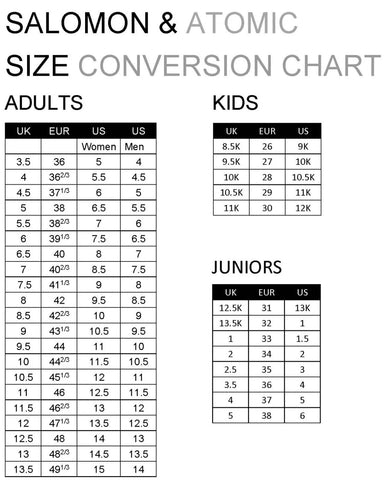
Sizing Chart: EU to US Conversion
Salomon uses European (EU) sizing. Use this chart to convert accurately.
| UK | EU | US Men | Foot Length (cm) |
|---|---|---|---|
| 3.5 | 36 | 4 | 22.1 |
| 5 | 38 | 5.5 | 23.3 |
| 7 | 40 2/3 | 7.5 | 25.0 |
| 8 | 42 | 8.5 | 26.0 |
| 9 | 43 1/3 | 9.5 | 27.0 |
| 10 | 44 2/3 | 10.5 | 28.0 |
| 11 | 46 | 11.5 | 29.0 |
| 12 | 47 1/3 | 12.5 | 30.0 |
| 13 | 48 2/3 | 13.5 | 31.0 |
| 14 | 50 | 14.5 | 32.0 |
📏 Best Practice: Measure your foot from heel to longest toe in centimeters, then match to the “Foot Length” column.
Example: If your foot measures 28.0 cm, you need EU 44 2/3 (US 10.5).
Final Tips for the Perfect Fit
For First-Time Buyers
- Try before you buy — especially if you have wide or high-volume feet.
- Order multiple sizes online if in-store isn’t possible (REI, Backcountry, Zappos allow returns).
- Stick to TTS unless you have wide feet or thick socks.
- Break them in gradually — no 10-mile hikes on day one.
For Repeat Salomon Wearers
- Don’t assume consistency — fit changes between model years.
- Re-measure your feet — they can grow or change shape.
- Orthotics? Removing the insole adds space — consider sizing up.
For Wide-Footed Hikers
- Choose wide models when available (e.g., XA Pro 3D Wide).
- Size up by 0.5–1 if wide version isn’t available.
- Avoid narrow models like XT-6 or Sense Ride unless sizing up.
Key Takeaways

- Salomon hiking boots run small and narrow — especially newer models.
- Fit varies by model and year — never assume consistency.
- Break-in softens materials, but boots don’t stretch significantly.
- Do not size up just for break-in — this risks heel slippage.
- If between sizes, go up 0.5 — especially with thick socks.
- Wide feet? Choose wide models or size up.
- Always test fit in person when possible — REI is a great option.
- Use EU sizing and measure in cm for accuracy.
✅ Bottom Line: The snug feel is by design. With the right size and gradual break-in, Salomon boots deliver unmatched trail performance. But your foot — not the box — should decide the size.
Take the time to get it right. Your feet will thank you on mile 12.