Scarpa Hiking Boots Fit Guide
If you’ve ever stood in a gear shop or scrolled online wondering, “How do SCARPA hiking boots fit?”—you’re asking the right question. SCARPA is renowned for building high-performance alpine, trekking, and mountaineering footwear that combines precision engineering with rugged durability. But here’s the catch: SCARPA boots don’t follow a one-size-fits-all rule. What fits perfectly in one model might feel cramped or loose in another—even if it’s the same size.
The reason? SCARPA tailors each boot to a specific foot shape and activity using different lasts (the molds used to shape the boot), and they use multiple sizing systems depending on the type of boot. This means your fit isn’t just about length—it’s about volume, width, instep height, and how your foot behaves under load. Getting this wrong can lead to blisters, numb toes, heel lift, or worse—ending a climb early due to foot pain.
In this guide, we’ll break down exactly how SCARPA hiking boots fit across models, explain the sizing systems they use, and give you actionable steps to find your perfect fit—whether you’re tackling Kilimanjaro, backpacking the High Sierra, or scrambling up a rocky approach trail. You’ll learn how to measure your feet correctly, choose the right socks, lock in your heel, and even customize your boots for a glove-like feel.
SCARPA Sizing by Boot Type: Know Which System Applies to You

Hiking & Approach Boots Use EU Sizing
For most SCARPA hiking, trekking, and approach boots—like the Zodiac Pro GTX, Ribelle Tech, and Mont Blanc GTX—the brand uses European (EU) sizing, where each full size equals 6.6 mm. This finer increment allows for a more precise fit than US sizing.
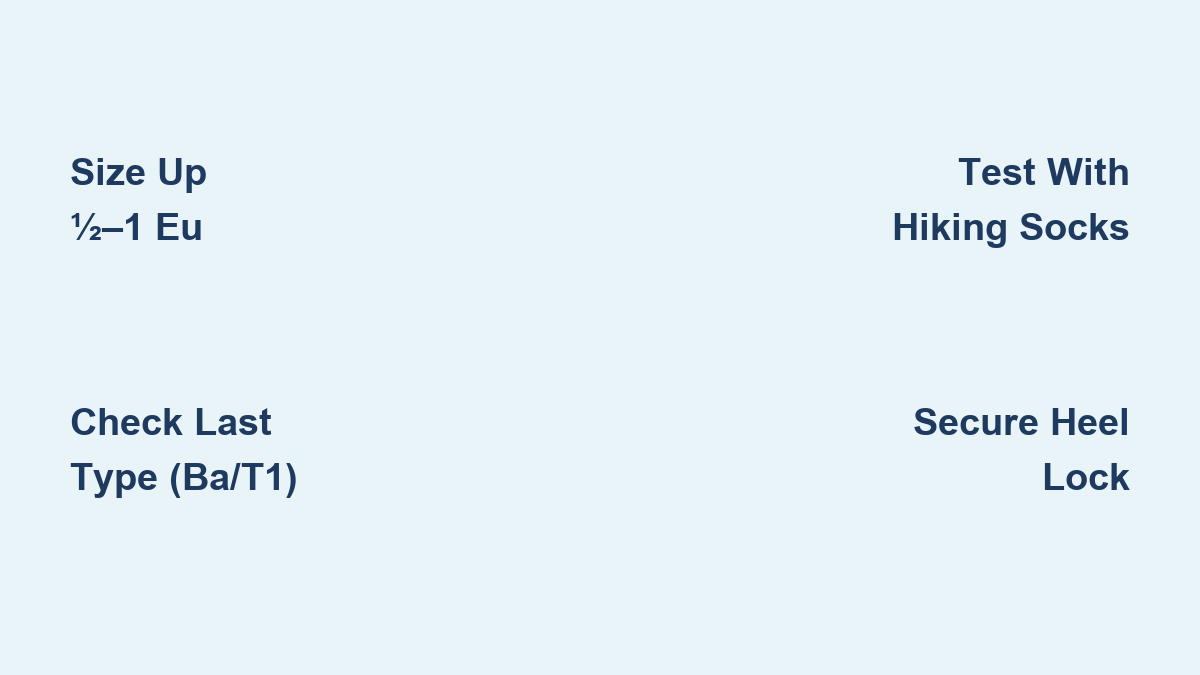
But don’t assume your street shoe size translates directly. Most hikers need to size up by ½ to 1 full EU size from their regular footwear. For example, if you wear a US 10 (EU 43), you may actually need a EU 44 or 45 in SCARPA hiking boots. Mountaineering-oriented models often require even more room—especially when wearing thick socks or expecting foot swelling at altitude.
✅ Pro Tip: Check the boot tongue—many SCARPA models label the last type (e.g., BA, T1) inside. This tells you whether the boot is wide-volume or narrow, which affects fit more than size alone.
Ski & Mountaineering Boots Use Mondo Point
For ski, ski mountaineering, and telemark boots—such as the Maestrale, F1, or TX Pro—SCARPA uses Mondo Point (MP) sizing, based on your foot length in centimeters. A 27.5 MP means the boot fits a 27.5 cm foot.
Here’s what makes it tricky: SCARPA ski boots “break on the half size.” That means:
– A 27.5 and 28.0 share the same shell length
– Only the liner is molded differently for the half-size difference
– The liner can be heat-molded for a custom fit
❗ Misconception Alert: A Scarpa 27 and 27.5 are not the same shell. The 27.5 is the true reference size—don’t assume half sizes are interchangeable.
Some advanced skiers downsize by up to 1 full Mondo size for a performance fit, but this should only be done after professional fitting and liner molding.
Plastic Mountaineering Boots Need Extra Room
For extreme environments, SCARPA’s plastic mountaineering boots—like the Phantom 6000 or older 8K models—use UK sizing, which aligns with US sizes in 8.4 mm increments. These stiff, insulated boots are built for high-altitude expeditions, so SCARPA recommends upsizing by ½ to 1+ sizes.
Why the extra space?
– To accommodate double-layer wool socks
– To allow for foot swelling at altitude
– To prevent toe bang during long descents
If you’re planning a summit bid on Denali or Everest Base Camp, this extra room is non-negotiable. A too-tight plastic boot can cause bruised toenails or even frostbite in cold conditions.
How SCARPA Fit Varies by Model: It’s All About the Last
Fit Depends on the Last
Not all SCARPA boots fit the same—even in the same size. That’s because SCARPA uses different lasts across its lineup. The last determines:
– Forefoot width
– Instep height
– Heel cup snugness
– Toe box volume
Two key lasts to know:
– BA Last: Wide, high-volume—ideal for average to wide feet (e.g., Zodiac Pro GTX)
– T1 Last: Narrow, performance-oriented—best for low-volume or narrow feet (e.g., Charmoz Pro)
🧩 Real User Experience: One hiker wore a EU 44 Ribelle Tech comfortably but found the Charmoz Pro in the same size too tight across the forefoot—same brand, different last.
If you find a SCARPA model that fits perfectly, note the last type. Future purchases on the same last will likely fit similarly.
Women’s Models Are Truly Gender-Specific
SCARPA was the first bootmaker to develop a female-specific last, designed with a slimmer midfoot and heel to suit lower-volume or narrower feet. Women’s models (e.g., Women’s Zodiac, Mont Blanc) aren’t just smaller—they’re shaped differently.
However, women with high-volume feet may still prefer the unisex last in a larger size. Don’t assume the women’s version is automatically better.
How to Size Up Correctly: Step-by-Step Fit Testing

Measure Your Feet Properly
The best time to measure is in the evening, when feet are naturally swollen.
Steps:
1. Stand barefoot on a hard floor with your heel against a wall
2. Mark the tip of your longest toe
3. Measure from wall to mark in centimeters
4. Use SCARPA’s Fit Calculator or Printable Fit Tool to convert to EU or Mondo size
Always measure both feet—many people have one foot longer than the other. Size to the larger foot.
Use the Footbed Test at Home
Before lacing up, try this foolproof method:
- Remove the insole
- Place it on the floor
- Stand on it wearing your hiking socks
- Check for 1–1.5 cm (about a finger’s width) of space beyond your longest toe
Also look for:
– Pinching across the ball of the foot
– Heel overhang
– Excessive side-to-side space
If your foot fills the footbed snugly with proper toe clearance, the boot size is likely correct.
⚠️ Warning: SCARPA boots have rigid forefeet—if your toes touch the front now, they’ll slam into it on descents.
Socks Are Part of the Fit System
Choose Technical Socks, Not Cotton
Cotton socks retain moisture, increasing blister risk. Always use technical hiking socks made of:
– Merino wool
– Synthetic blends (nylon, polyester)
– Targeted cushioning zones (heel, ball, toe)
Sock weight by boot type:
– Lightweight boots → thin to medium socks
– Heavy-duty boots → medium to thick socks
– Mountaineering boots → double-layer or insulated socks
Use Socks to Fine-Tune Fit
Socks can act as volume adjusters:
– Too much space? Try a liner sock + outer sock combo
– Still loose? Add an aftermarket footbed (e.g., Superfeet)
– Never wear more than two socks—if you need more, the boot is too big
❌ Myth: “I’ll break it in.” If the boot feels too big with correct socks, downsize.
Secure the Heel to Prevent Blisters
Lock the Heel Before Lacing
Heel lift is a leading cause of blisters. To prevent it:
- Press your heel fully into the boot before tightening laces
- Lace snugly from toe to ankle
- Use heel lock lacing (a.k.a. “lace lock” or “runner’s loop”) for extra security
This technique cinches the midfoot and ankle, keeping your heel planted during uphill climbs and downhill drops.
Relace During the Day
Feet swell and shift over time. Re-lace your boots:
– After breaks
– When transitioning from ascent to descent
– If you feel heel slippage or pressure points
🔄 Expert Move: Loosen the upper eyelets slightly if your instep feels tight after hours of hiking.
Fit for Specific Activities
Mountaineering Boots Need +1 Size Minimum
For high-altitude climbs (e.g., Kilimanjaro, Everest Base Camp), SCARPA recommends:
– +1 EU size from street shoes
– Room for double-layer socks
– No toe bang on long descents
Recommended models: Zodiac Pro GTX, Phantom 3 GTX, Mont Blanc GTX
Break in these boots over 100+ miles before your trip. Gore-Tex-lined models need time to conform.
Backpacking Boots: Balance Support & Comfort
For multi-day treks, aim for a +½ to +1 EU size. The boot should:
– Feel snug but not tight
– Allow slight toe lift when standing on tiptoes
– Stay secure under load
Stiff boots (e.g., Kinesis Pro) don’t stretch much—so fit must be right from the start.
Break in over 2–4 weeks:
– Week 1: Wear around the house (1–2 hrs/day)
– Week 2: Short walks (1–3 miles)
– Week 3+: Gradually add distance and pack weight
Approach & Technical Hiking: Closer to Street Fit
Approach shoes like the Ribelle Tech or Arpia often fit closer to street size, but many still size up by ½ EU.
Key considerations:
– Sock match: Medium-weight technical socks
– Width: If you have wide feet, look for BA last models
– Precision: These boots prioritize sensitivity—avoid excess volume
🔍 User Trend: “I wear a EU 44 in street shoes, size up to 45 in most hiking boots, but Ribelle Tech fits true to size.”
SCARPA vs. La Sportiva: Fit Comparison
La Sportiva Runs Narrower
Many users compare SCARPA to La Sportiva, another premium Italian bootmaker. Key differences:
| Feature | SCARPA | La Sportiva |
|---|---|---|
| Toe Box | Wider options (BA last) | Narrower, especially big toe |
| Sizing | Often +½ to +1 EU | Frequently requires +1 EU |
| Best For | Average to wide feet | Narrow to medium feet |
🗣️ User Feedback: “La Sportiva feels like it’s squeezing my big toe. SCARPA gives more room.” – EgorrEgorr
If you have narrow feet, La Sportiva might feel more secure. If you have wide or high-volume feet, SCARPA’s BA last models are often a better match.
Fixing Common Fit Problems
Toes Hitting Front on Downhill?
Fix: Upsize by ½–1 EU, ensure 1 cm space at toe
Heel Lifting?
Fix: Use heel lock lacing, add a volume-reducing insole
Blisters?
Fix: Break in boots, wear moisture-wicking socks, apply moleskin
Numb Toes?
Fix: Upsize, check toe box volume, loosen upper laces
Boot Feels Too Big?
Fix: Try a narrower last (T1), use aftermarket footbeds, or downsize
Customize Your Fit

Add Aftermarket Footbeds
High-performance insoles like Superfeet, Lynx, or custom orthotics:
– Improve arch support
– Fill excess volume
– Reduce heel slippage
– Compensate for up to ½ size difference
✅ Works especially well in stiff boots with minimal compression.
Heat-Mold Liners for Perfect Fit
Many SCARPA boots (e.g., ski and mountaineering models) have Intuition heat-moldable liners. These can be:
– Baked in a boot oven (180°F for 5–8 minutes)
– Worn during cooling to conform to your foot
– Re-molded multiple times
This is one of the best ways to customize fit without altering the shell.
Break In Boots Before the Trail
SCARPA does not cover fit issues under warranty. You must confirm fit indoors before outdoor use.
Break-in schedule:
– Days 1–3: Wear around the house (1–2 hrs/day)
– Days 4–7: Short walks on pavement or trails
– Week 2+: Gradually increase distance and pack weight
Watch for hotspots—treat them early with blister pads.
Use Return Policy Wisely
Most retailers (e.g., Backcountry, REI) allow 28-day returns if boots are not worn outside.
At-home test checklist:
1. Wear correct socks
2. Walk up and down stairs
3. Simulate hiking stance (knees bent, slight forward lean)
4. Check heel lock, toe space, width
5. Return if any discomfort
🔄 Free returns are your safety net—use them.
Final Fit Checklist
✅ Length: 1–1.5 cm past longest toe when standing
✅ Width: No pinching; foot fills boot evenly
✅ Heel: No slippage on stairs
✅ Ankle: Snug but not tight; collar doesn’t rub
✅ Lacing: Secure from toe to ankle
✅ Socks: Matched to boot type and climate
✅ Load Test: Try with backpack (10–20 lbs)
Key Takeaways
- SCARPA hiking boots use EU sizing—most people size up by ½ to 1 size
- Fit varies by last—BA is wide, T1 is narrow
- Measure feet in the evening and use the footbed test
- Never skip break-in—especially for stiff, high-performance models
- Use technical socks and aftermarket footbeds to fine-tune fit
- Heel lock lacing prevents blisters
- Mountaineering boots need extra room for socks and swelling
- Test at home—do not wear outside before confirming fit
When in doubt: Size up, test thoroughly, and prioritize long-term comfort. A perfect SCARPA fit isn’t just possible—it’s within reach with the right knowledge.