Boot Fitting Guide: Quick Steps
Nothing ruins a day faster than boots that pinch, slip, or rub. Whether you’re stepping into cowboy boots for a night out, hiking through snow, or strapping into ski boots at the resort, proper boot fitting is essential for comfort, performance, and long-term foot health. This boot fitting guide breaks down the science and strategy behind getting the right fit, with no guesswork and no pain.
You will learn how to measure your feet correctly, decode sizing systems like Mondopoint and US width codes, and understand why ski boots should feel tight. We cover fashion, western, and performance boots, with actionable steps to avoid common fit issues like numbness, cramping, and heel slippage. If you have ever returned boots because they just did not feel right, this guide will change how you shop forever.
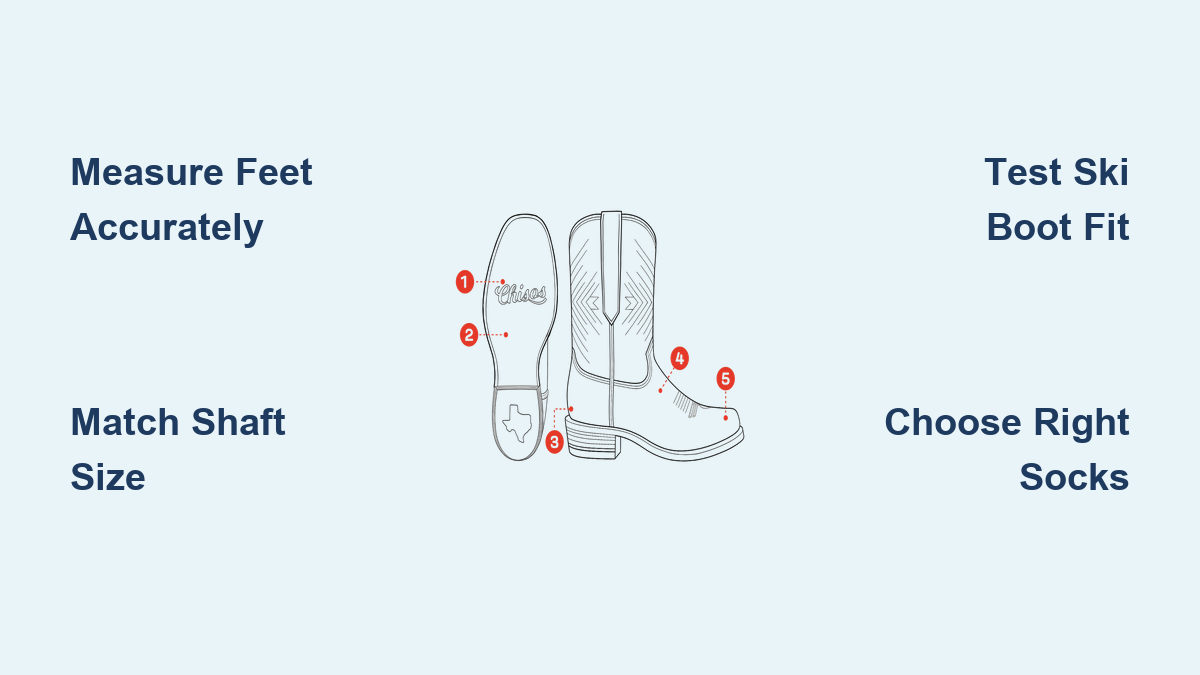
Measure Your Feet Correctly

Before you pick a style, you need accurate measurements. Most people wear the wrong size, not because they guess poorly, but because they measure wrong.
Trace and Correct Your Foot Outline
Use this method for western, fashion, and casual boots:
1. Sit down and place your foot on a large sheet of paper.
2. Wear the socks you plan to use with your boots.
3. Hold a pencil perpendicular to the paper and trace around your foot.
4. Measure the longest and widest points of the outline.
5. Subtract 0.2″ from both dimensions to account for pencil thickness.
Now compare your corrected numbers to the brand’s size chart, not a generic conversion chart. Always check both length and width.
Assess Instep Height
Your instep (the arch across the top of your foot) affects how a boot feels, especially in snug styles like cowboy or ski boots.
- High instep: Harder to get boots on; may need wider shafts or stretchable materials.
- Low instep: May cause heel slippage in rigid boots.
- Medium instep: Standard fit for most lasts.
Knowing your instep helps avoid boots that feel too tight on top even when the length is right.
Know Your Shaft Size
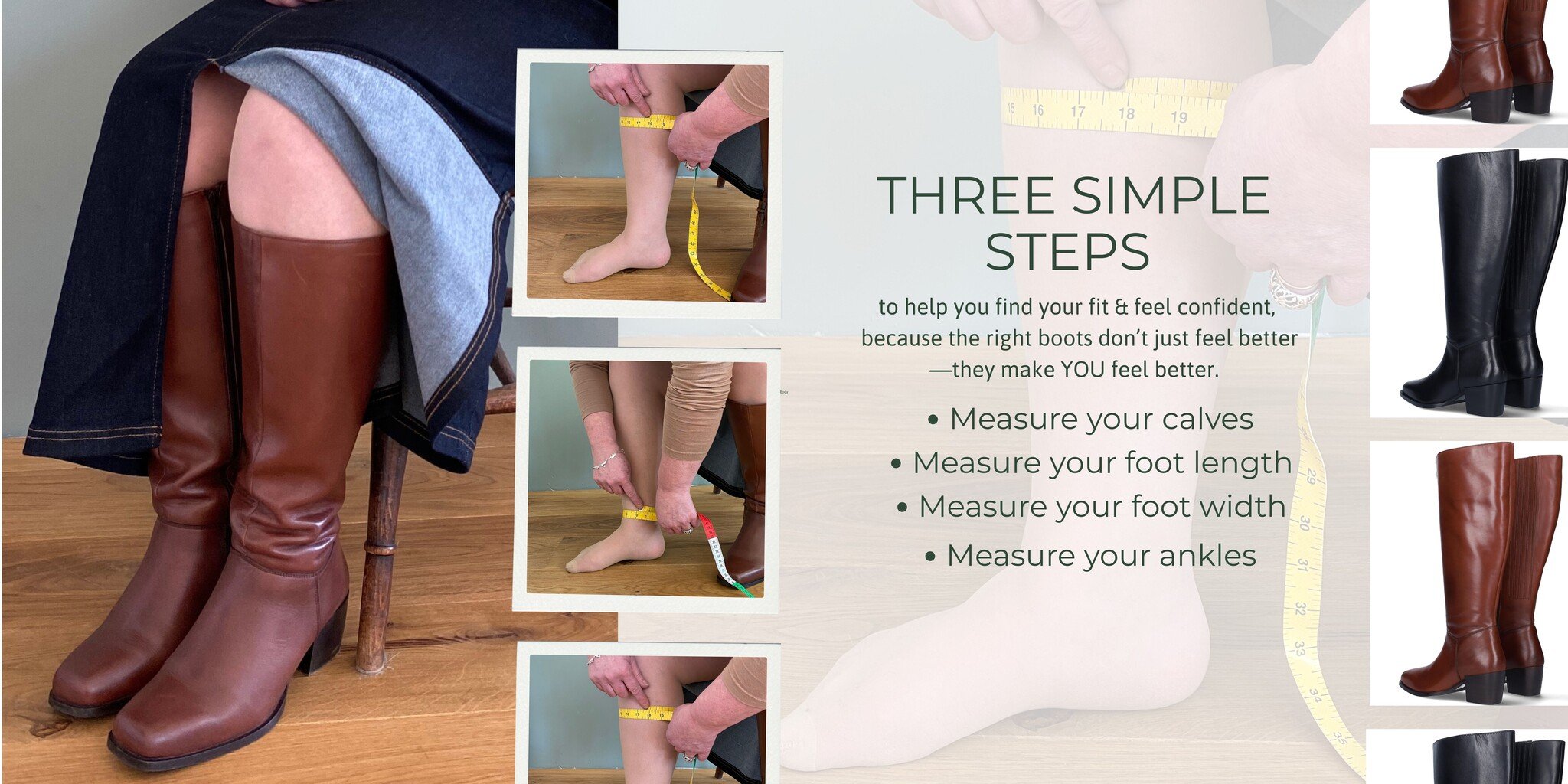
The shaft, the part that wraps around your calf, must fit both vertically and circumferentially. A boot can be the perfect shoe size but still fail if the shaft does not match your leg.
Match Shaft Height to Your Leg
Shaft height determines where the boot lands on your leg:
– Ankle/Booties (3″–8″): Sit below the calf, ideal for slim jeans or dresses.
– Mid-Height (8″–11.5″): Covers lower calf; common in moto and western styles.
– Knee-High (11.5″–15″): Ends just below the knee. Measure from floor to kneecap minus 1″.
– Over-the-Knee (15″+): Requires precise measurement from heel to desired top point.
Pro Tip: Always measure your leg height bare-legged and standing. Sitting shortens the calf.
Choose the Right Calf Width
Measure the fullest part of your calf with a soft tape. Then add ¼” to 1″ for comfort, especially if wearing jeans or thick socks.
Calf width categories:
– Narrow: 14″ and under
– Regular: 14″–16″
– Wide: 16″–18″
– Extra-Wide: 18″ and up
If you are between sizes, size up in width, not length. A boot that is too long will cause heel slip and instability.
Understand Heel Height and Stability
Heel height affects how you walk, stand, and balance, beyond just style.
Classify Your Heel Type
- Flat (0″–1″): Maximum stability, easy walking.
- Low (1″–2″): Comfortable for all-day wear.
- Mid (2″–3″): Stylish yet manageable.
- High (3″–4″): Requires stronger ankle control.
- Ultra-High (4″+): Best with block heels or platforms for support.
Prioritize Stability Over Height
A 4″ stiletto may look dramatic, but a block heel or wedge provides far better balance and reduces foot fatigue. If you are on your feet all day, choose supportive shapes, even in fashion boots.
Warning: High heels shift weight forward, increasing pressure on the ball of the foot. Look for cushioned insoles or rocker soles to offset this.
Use the Right Sizing System
Not all boots use standard shoe sizes. Confusing a US men’s 10 with a Mondopoint 270 can lead to painful mistakes.
Decode the Mondopoint System (Ski Boots)
Ski boots use Mondopoint, measured in centimeters of foot length:
– Mondo 23 = 23 cm from heel to toe.
– Always measure your longer foot.
Never convert directly from US size. Use this chart:
| Mondo (cm) | Women’s US | Men’s US |
|---|---|---|
| 25.0 | 8.5 | 7 |
| 26.0 | 9.5 | 8 |
| 27.0 | 10.5 | 9 |
| 28.0 | 11.5 | 10 |
Key Fact: Most ski boots do not have true half-sizes. A 27.0 and 27.5 share the same shell; the difference is inliner thickness.
Apply the US Width System (Cowboy Boots)
Cowboy boots use a linear width scale with 3/16″ increments:
– Women’s Standard: B
– Men’s Standard: D
– Narrowest: AAA
– Widest: EEE
Widths vary by bootmaker, leather type, and last shape. Handmade boots may run tighter or looser, so always try them on.
Fit Ski Boots Like a Pro

Ski boots are performance tools designed for power transfer and control, not cozy comfort.
Embrace the “Suspiciously Snug” Fit
A new ski boot should feel tight but not painful, like a firm handshake.
Ideal fit signs:
– Toes press lightly against the front when standing.
– Even pressure across the foot and lower leg.
– No heel lift when flexing forward.
Myth Busting: Boots do not break in by getting tighter. Liners pack out over time (80–100 ski days), making the boot looser.
Perform the Shell Fit Test
This test checks if the shell, not just the liner, fits your foot:
1. Remove the liner.
2. Insert your foot (in ski socks) into the empty shell.
3. Slide your toes to the front.
4. Measure the gap behind your heel.
Gap Guide:
– >2 cm: Too big
– 1.5–2 cm: Ideal for most skiers
– <1.5 cm: Tight, high-performance fit
Dowel Test (Advanced):
– 1″ gap: Recreational fit
– 3/4″: Avid skier
– 1/2″: Expert level
Smaller gaps mean faster response but less comfort.
Fix Heel Hold Issues
A slipping heel ruins control and causes blisters. But not all heel movement is bad.
Lock the Heel During Flex
Your heel should stay locked in the heel pocket when you bend your knees forward. If it lifts, the boot is likely too big or the wrong shape.
Normal: Slight lift when standing on tiptoes, which is natural foot motion.
Problematic: Heel rises during skiing stance, which means poor fit or limited ankle mobility.
Test Your Ankle Flexibility
Stand barefoot and squat:
– If your knees pass your toes, you have good mobility and can opt for higher forward lean.
– If your heels lift, you need a more upright boot (≤13° forward lean).
This test determines whether your body can handle aggressive boot geometry.
Customize for Comfort and Performance
Even the best shell needs tweaks to match your unique anatomy.
Upgrade Your Footbed
Stock insoles are flat and generic. Replace them:
– Cut-to-fit insoles: Basic support.
– Custom-molded footbeds: Heat-molded to your arch and heel.
– Orthotics: For medical conditions like plantar fasciitis.
A good footbed stabilizes your foot, prevents cramping, and improves ski control.
Heat Mold Liners and Shells
Many liners can be heat-molded in-store or at home:
– Warm liner, insert foot, flex for 10 minutes.
– Conforms to foot shape, reducing pressure points.
Shell molding (done by pros) can add toe room or relieve bony pressure, which is ideal for high insteps or bunions.
Adjust Cuff Canting
If you are bowlegged or knock-kneed, your boots may not align with your natural stance.
Test: Stand with feet together.
– Feet touch first? Bowlegged; needs outward canting.
– Ankles touch first? Knock-kneed; needs inward adjustment.
Canting adjusts the boot cuff angle. Done wrong, it causes knee strain. Get it from a certified fitter.
Prevent Common Fit Problems
Most boot pain is preventable. Here is how to stop issues before they start.
Stop Cramping and Burning
Cause: Weak foot muscles, not always the boot. Skiing demands constant micro-adjustments that tire underdeveloped stabilizers.
Fix:
– Do barefoot balance drills off-season.
– Practice single-leg stands and calf raises.
– Wear proper footbeds to reduce fatigue.
Boots that are too big or too wide also contribute, so ensure correct shell fit.
Avoid Numbness
Numb toes or feet are likely due to:
– Over-tightening the instep buckle.
– Too-thick socks restricting circulation.
– High instep pressure from a narrow boot throat.
Rule: Buckle snug, not crushing. Use thin, moisture-wicking socks only.
Choose the Right Socks
Socks make or break the fit, especially in ski boots.
Follow the “Thin to Win” Rule
Best Materials:
– Merino wool
– Synthetic blends (polyester, nylon)
– Elastic for snug, consistent fit
Never Wear:
– Cotton (holds sweat, causes blisters)
– Thick hiking socks (indicates oversized shell)
Critical: Thick socks do not fix a big boot; they reduce circulation and create friction.
Skip the Baselayer Tuck
Do not let long underwear (long johns) go inside the boot. It bunches, creates friction, and pushes the liner out of place.
Fix: Use ¾-length baselayers or trim excess material.
Don’t Fall for the Rental Trap
Ill-fitting rental boots are the number one reason people quit skiing.
Why Rentals Fail:
– One-size-fits-all approach.
– Liners packed out from hundreds of uses.
– No customization for foot shape or skill level.
Solution: Invest in properly fitted boots. Even mid-range custom-fitted boots outperform top-tier rentals.
Know When to See a Pro
Not all fitters are equal. A good boot fitter:
– Listens to your goals (recreational vs. expert).
– Explains the fit process clearly.
– Spends at least one hour on your first fitting.
– Offers follow-up adjustments.
Red Flags:
– Only uses size charts.
– Says “they’ll stretch in.”
– Rushes the appointment.
Ski boot fitting is iterative. Return for tweaks after a few days on snow.
Compare Fit Standards by Boot Type
Different boots have different fit rules. Know what to expect.
| Feature | Fashion Boots | Cowboy Boots | Ski Boots |
|---|---|---|---|
| Fit Goal | Comfort + style | Snug, molds over time | Firm, zero movement |
| Toe Space | Room to wiggle | Firm contact | Touch front when standing |
| Heel Slip | Minimal OK | Minimal OK | None during flex |
| Sizing Basis | US/EU | US Width + last | Mondopoint + shell test |
| Break-in | Softens with wear | Leather stretches | Liner packs out |
| Socks | Style-dependent | Medium/thick | Thin only |
Use this table to reset expectations, especially if switching between boot types.
Frequently Asked Questions About Boot Fitting
What is the Mondopoint system and why do ski boots use it?
Mondopoint measures foot length in centimeters, providing a more accurate fit than US sizing. Ski boots use it because direct foot measurement prevents the 1–2 size errors common when converting from US sizes.
How tight should ski boots feel when new?
Ski boots should feel like a firm handshake: tight but not painful. Toes should lightly touch the front when standing, and heels should stay locked when flexing forward.
Do boots actually break in and stretch?
Leather fashion and cowboy boots soften and stretch with wear. Ski boots do the opposite; their liners compress (pack out) over 80–100 days, making the fit looser over time.
Why are thick socks bad for ski boots?
Thick socks indicate an oversized shell. In a properly fitted boot, they reduce circulation and create friction, leading to cold toes and blisters.
How do I know if my cowboy boots fit correctly?
Cowboy boots should feel snug across the instep with firm toe contact and minimal heel slip. Width follows a 3/16″ linear scale, with B standard for women and D standard for men.
What is a shell fit test?
A shell fit test measures the gap between your heel and the back of the empty boot shell. A 1.5–2 cm gap is ideal for most skiers, while smaller gaps suit advanced performance needs.
Key Takeaways for Your Best Boot Fit
The perfect boot comes down to shape, volume, and function, not just size. Start with accurate foot measurements, match the sizing system to your boot type, and never skip the shell fit test for ski boots. Remember that custom footbeds, heat-molded liners, and proper cuff alignment transform a good fit into a great one.
Your next step is simple: measure both feet today, identify your instep height, and check your longer foot against the Mondopoint or US width chart before your next boot purchase. Comfort, confidence, and blister-free days are waiting on the other side of a proper fitting.